Temple of Deceit
Land
This land enters tapped.
When this land enters, scry 1. (Look at the top card of your library. You may put that card on the bottom.) : Add
: Add  or
or  .
.
- CMC
- 0
- Mana cost
- Color identity
- BU
- Rarity
- rare
- Set
- Doctor Who
- Price
- —
- EDHREC rank
- #324
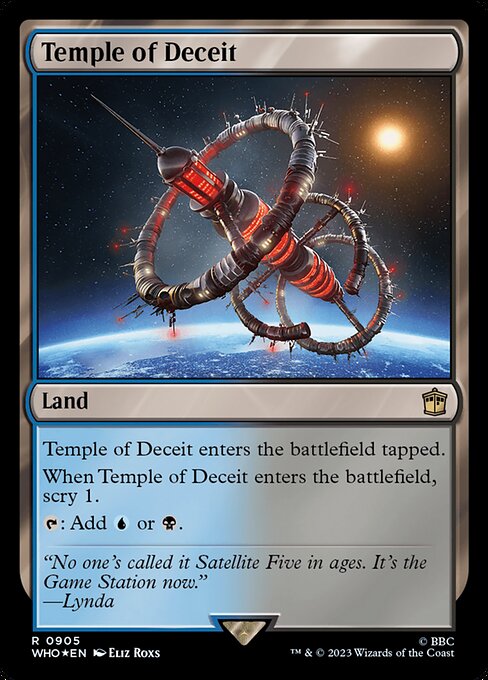
Temple of Deceit enters tapped and scries 1 — that's the whole deal: a free look at your next draw stapled to a dual land that costs you a tempo point the turn you play it. In Dimir and three-color shells that want both blue and black mana, that scry is almost always worth the one-turn delay, and commanders like Aminatou, Veil Piercer that care about what's on top of your library turn that incidental filtering into genuine deck manipulation.
Best Commanders
Commanders with the highest synergy

Aminatou, Veil Piercer
Aminatou, Veil Piercer's ability to exploit the top of your library makes every scry effect pull extra weight, and Temple of Deceit delivers that filter the moment it enters — setting up her triggers or stacking your next draw exactly when you need it.
Temmet, Naktamun's Will
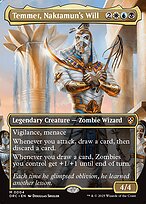
Temmet, Naktamun's Will runs Dimir as its core color pair, and Temple of Deceit is simply one of the better budget-accessible dual lands available to it — the scry helps smooth draws in a deck that wants to be hitting its curve consistently.
Davros, Dalek Creator
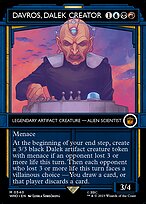
Davros, Dalek Creator operates in Dimir and rewards consistency above all else; Temple of Deceit slots in as reliable color fixing that also trims dead draws off the top before Davros's card-advantage engine comes online.
Yennett, Cryptic Sovereign
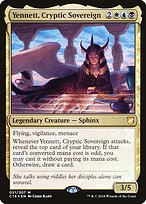
Yennett, Cryptic Sovereign cares deeply about the top card of your library, and Temple of Deceit's enter-tapped scry directly feeds that — sculpting the top so Yennett's attack trigger hits something impactful rather than a land.
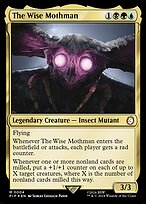
The Wise Mothman
The Wise Mothman spreads across multiple color identities, but its Dimir builds lean on Temple of Deceit for fixing plus the minor-but-real upside of scrying into radiation counters or key proliferate pieces a touch more reliably.
Format Analysis
Where it lives, where it can’t
| Format | Verdict |
|---|---|
| commander | legal |
| legacy | legal |
| modern | legal |
| pioneer | legal |
| standard | legal |
| vintage | legal |
| pauper | not legal |
| oathbreaker | legal |
In Commander, Temple of Deceit is a role-player rather than a staple — it earns its slot in any Dimir or three-color deck that includes blue and black and doesn't have the budget for shock lands or original dual lands. The scry 1 is genuinely useful in a 100-card singleton format where finding the right piece matters, and the tempo loss of entering tapped is least punishing in a multiplayer game where turn one rarely decides anything. In competitive 60-card formats like Modern and Pioneer, Temple of Deceit struggles: the enters-tapped clause is a real cost when opponents are threatening on turn one, and faster dual land options have largely pushed the scry lands to the margins. Legacy and Vintage have access to the original dual lands, making Temple of Deceit irrelevant there in any serious build. Standard legality opens it up for budget-conscious players who can't access shocks, where the scry offers meaningful value in slower, more controlling archetypes.
Key Combos
Combo lines featuring this card
Price Context
Current price
unknown tier
Pricing data for Temple of Deceit isn't available in this context, so check Scryfall or your preferred vendor for the current market rate. Historically, scry lands have stayed affordable given their multiple reprints, making Temple of Deceit an easy pickup for budget Dimir Commander builds.
Explore
Sources
Updated . Data from Scryfall, EDHREC, and Commander Spellbook.